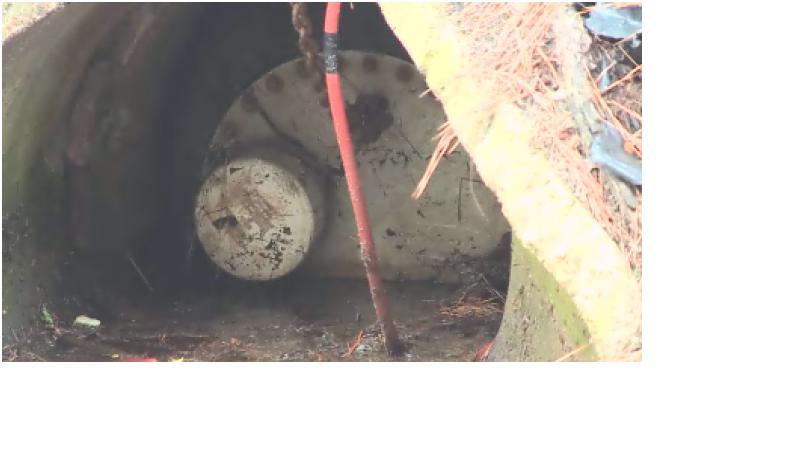
Cape Story residents are concerned that the City’s interim plug is in the wrong spot and will not protect all 40 homes in the tidal flooding zone.
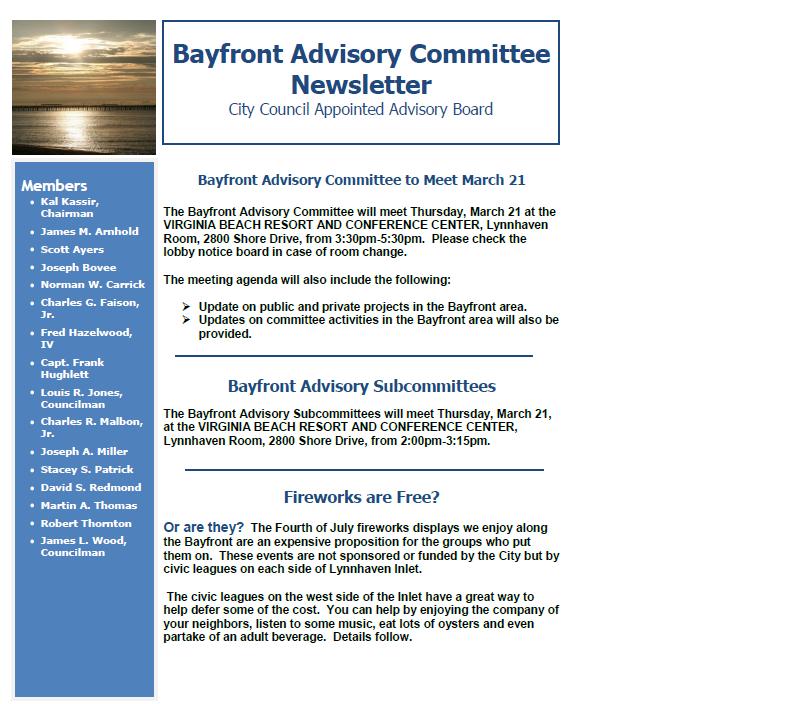
Click here to read the entire Bayfront Advisory Committee Newsletter VisionNewsletter 3 3
One Tree. Why bother saving one tree? Well, in order to get to your destination, you have to take one step at a time.
Please take a minute and sign the online petition to show the property owner that One Tree really does matter. Click here for the petition
http://www.ipetitions.com/petition/save-live-oak-at-bar-harbor/
Here are several additional reasons why saving one tree is a good thing.
For more about saving Live Oak Trees, visit www.friendsofliveoaks.org
Click here for a printable versions of the agenda SDCC FEB 2013 Agenda (1)
Shore Drive Community Coalition
Monday 25 FEB 2013
SDCC General Meeting
SDCC General Meeting – Monday, 25 FEB – 7:30-8:30 pm
Ocean Park Volunteer Rescue Squad Station (Intersection of Shore Drive and East Stratford Rd.)
Call to order
Meeting topic: (1) Neighborhood Security Measures for residents
(2) VA State Personal Self Defense Laws by David Williams
Officers’ Reports:
President’s Report David Williams
Vice President’s report Rick Mercadante
Secretary’s Report Todd Solomon –Jan Minutes
Treasurer’s Report Ryan King
Update on issues:
Old Business
New Business
Adjourn
Please check www.sdcc.info for more information on area news and events
The following was taken from WTKR’s website:
UPDATE: As of 4:00pm., Shore Drive remains closed to East Bound traffic from Kendall Street to Fort story.
Virginia Beach, Va. – Police tell NewsChannel 3 one person has died and one has been injured in a vehicle crash on Shore Drive near First Landing.
It happened at 1:15 p.m., Thursday, February 14, 2013, in the 2500 block of Shore Drive near First Landing. Police say a vehicle was heading eastbound in the 2500 block of Shore Drive near First Landing Park, when it crashed.
One person was reported deceased; and a second person was injured.
Eastbound traffic on Shore Drive is closed from Kendall Street to Fort Story.
NewsChannel 3 is working to find more details. Watch starting First at Four for updates.
The City of Virginia Beach invites all residents, business owners, community leaders and other stakeholders who have an interest in how the city plans, manages, protects and promotes its current and future sustainability initiatives to participate in the City Council’s review and adoption of “A Community Plan for a Sustainable Future” over the next several weeks.
The City Council will be holding a public comment session on Tuesday, Feb. 12 beginning at 6 p.m. in the City Council Chamber, Building 1, 2401 Courthouse Drive, 2nd Floor.
The City Council will also be holding a public hearing and vote on adoption of the plan on Tuesday, Feb. 26 beginning at 6 p.m. in the City Council Chamber, Building 1, 2401 Courthouse Drive, 2nd Floor.
The draft plan is available for the public to review prior to these meetings at http://www.vbgov.com/government/offices/eso/sustainability-plan/Documents/vb-sustainability-plan-web.pdf. These public input meetings are the final steps in a yearlong public outreach process to seek ideas and direction from citizens to help guide the City in the development of its first comprehensive Community Sustainability Plan.
For additional information, please contact Clay Bernick in the Planning Department/Environment and Sustainability Office at 385-4899 or visit www.VBgov.com/sustainplan.
The Bayfront Advisory Committee will meet Thursday, Feb. 21, at the Virginia Beach Resort and Conference Center, 2800 Shore Drive, from 3:30 p.m. to 5:30 p.m.
The agenda for the meeting will include the following:
There will be an opportunity for presentations from the public on projects in the Bayfront area. The committee generally concludes its deliberations around 4:30 p.m. The meeting is then opened to the public for comments.
Also, the Bayfront Advisory Design Subcommittee will meet on Feb. 21 from 2 to 3:15 p.m. at the Resort and Conference Center. The subcommittee will continue its deliberations regarding recommendations for commercial design standards along the Shore Drive corridor.
For additional information or to obtain a copy of the draft agenda, contact Faith Christie in the Planning Department at (757) 385-4621 or fchristi@vbgov.com. For more information regarding the Bayfront Advisory Committee, visit www.VBgov.com/Bayfront.
The Chesapeake Bay and her precious wetlands need your help TODAY.
Senate Bill 926, a measure that weakens the authority of local wetlands boards, will be considered at tomorrow’s Senate Agriculture, Conservation, and Natural Resources. Your state senator, Sen. Jeff McWaters, has introduced this bill. Please ask Senator McWaters to withdraw this bill, which will have unintended harmful consequences.
CBF and many other conservation organizations oppose this bill, as it undermines Virginia’s effective, four-decades-old tidal wetlands program that relies upon local citizen wetland boards, with oversight by the Virginia Marine Resources Commission (VMRC), to protect our valuable tidal wetlands.Time is of the essence. Please contact Sen. McWaters today, and tell him SB 926 is a step backward and to please withdraw it immediately!
Here is some more background information regarding SB926. The attached document was pulled from this year’s City Legislative Agenda and was used to start the ball rolling on SB926.
10. Governmental activity in wetlands owned, leased or within an easement or right to use held by the Commonwealth or a subdivision thereof or a local government approved neighborhood navigation dredging project within a Special Services District adopted by the local governing body in accordance with Va. Code Section 15.2-2400, et seq.
170 4. For governmental activity not falling within the exceptions set forth in § 3 (10) above,
the board shall not condition approval on compensatory mitigation for adverse impacts if compensatory mitigation is required for the same activity by the Commission pursuant to Title 28.2 of the Code of Virginia, the Department of Environmental Quality pursuant to Title 62.1 of the Code of Virginia or § 401 of the Clean Water Act, or the United States Corps of Army Engineers pursuant to § 404 of the Clean Water Act and § 10 of the Rivers and Harbors Appropriations Act of 1889
SB926 is a modification of the existing law regarding government activities in wetlands. The City Council has asked that the language be modified to expand the definition of government projects to include bon-a-fide easements and the Navigation SSD Dredging Projects. These additions modify the 1992 law of Va. Code Section 28.2-1302. The specifics are:
- 1. In Section 3, Paragraph 10, the addition of “or within an easement or right of use held by the Commonwealth or a subdivision thereof.” The absence of reference to a legally binding easement has significantly disrupted the ability of government entities to implement timely and cost effective projects when substantiated, documented, and City Attorney validated legal instruments allowing the public use of property are in existence. The “right of use” reference addresses the potential existence of a documented conveyed right other than title, easement or lease. This instance occurred in the construction of the Constitution Drive Extension across Thalia Creek in Virginia Beach which delayed construction for over 12 months while properties were dedicated and accepted by the Council to establish the relationship of fee simple ownership.
- 2. Also in Section 3, Paragraph 10 was the inclusion of additional specifying language, “or a local government approved neighborhood navigation dredging project within a Special Services District adopted by the local governing body in accordance with VA.Code Section 15.2-2400.” This language is added to specifically allow SSD Navigation Projects to be considered government projects as they are engineered, constructed, funded and administered by local government staff and therefore, also exempt from Local Wetlands Board review. This in no way is intended to amend or circumvent the State and Federal permitting process. All navigation SSD projects will have permit applications submitted through the Joint Permit Application Process managed by VMRC for the purpose of obtaining State permits from both DEQ and VMRC as well as federal permits from the Corps of Engineers. This specific exemption from Local Wetlands Board review solidifies the need for all three segments of the neighborhood SSD projects (City spur, neighborhood SSD channel, and individual connections) as being the complete project for the purpose of design, permitting and contracting. By making these projects a government activity all mitigation becomes eligible for use in a government mitigation bank which the City of Virginia Beach is establishing as a result of the Pleasure House Point Purchase and its partnership with the Chesapeake Bay Foundation. It is essential this specific language be included in Senator McWaters’ bill so that Lynnhaven River Now can create a Trust for the oversight of mitigation funds related to impacts in the Lynnhaven.
So as you see, this is a definitional clarification for what constitutes a government project that is exempt for local wetland board review. The City Council sponsors feel that a permit application submitted by the City Manager’s Office to perform a City Council directed Navigation SSD Project that has been formulated by the City staff charged with providing the regulatory staff research and recommendations for the Local Wetlands Board creates a conflict of interest. The staff that prepares the application should not be the staff support charged with reviewing and recommending approval of that application. Currently the definition of “governmental activity” for the Local Wetland Boards, due to legislation for the Virginia Marine Resources Commission (VMRC), is limited to lands the government either owns or holds an easement or right-of-way over. The language must be modified as it is antiquated and not consistent with the SSD legislation, which was created decades after VMRCs legislation. This in no way circumvents the state and federal permit review and approval process which this City adheres to on all government projects.
The neighborhood SSD program created by the City Council of Virginia Beach, following state enabling legislation available to all coastal communities in Virginia, is a tremendous opportunity for waterfront residents to regain navigable access to city channels. The SSD program is an essential program for many neighborhoods who could not otherwise dredge because the city is able to bundle the regulatory process, tax residents over a period of 16 years, thus building in a means to finance the effort making it cost effective. Additionally, the “mud tax” which the City’s wetland board collects from private residential projects does not take into account that exposed sediment (“non-vegetated wetland” – or “mudflat” exposed at low tide) is “natural” versus a consequence of sedimentation from surrounding development. The “mud tax” adds $112.50/cy ($12.50 per square foot x 9 square feet per cubic yard) to the cost of a project currently estimated to cost $30/cy (surveying, engineering, permitting and dredging) to remove the mud. It is this outrageous mud tax that has caused these project to be unaffordable. In a matter of speaking this tax could be viewed as a prohibition to the property rights of waterfront home owners.
The Local Wetland Board does not have jurisdiction over subaqueous river bottoms. These Projects will help to restore the environmental quality of the Lynnhaven River by improving the volume of water flow which will improve the tidal cleansing of the river. All of which will improve the health of fish and shell fish in the river which is of major environmental benefit to the city and its citizens. I could understand the concern that the Local Wetland Board would have regarding tidal wetlands located around the point where dredge spoils are removed from the river but this will be covered in the state and federal permitting. Notwithstanding their normal concerns, all of the Projects are located within the river proper and not in the tidal wetlands. It would appear that the only other concern that the Local Wetland Board could possibly have is where non-vegetative wetlands and subaqueous river bottom overlap. Subaqueous river bottom and non-vegetative tidal wetlands are generally one in the same and determining where one starts and stops is of no environmental consequences. Finally, the public is not further served in any way by requiring the waterfront property owner and the public to spend additional time and money to file and process redundant permits with their City Council appointed Local Wetland Board. Additionally, the fees that the Wet Lands Board could impose on the property owners were arbitrarily established several years ago by the Local Wetland Board without empirical environmental or economic basis. It is beyond reason to require the property owner to submit to additional public hearings only for the property owners to be required to pay additional fees. To simply duplicate the review of the state and federal agencies that have jurisdiction over such project with an unnecessary local bureaucratic layer is not appropriate.
Dominion Power will be cutting down the row of trees and vegetation immediately north of Shore Drive to reduce possible damage to power lines.
Traffic delays may be possible.
Click here to read the public notice Northampton Letter(2)
Arena Town Hall Meeting to Be Held Tuesday Dec. 18th
The newly formed Citizen Advisory Committee for the proposed arena project will hold a public Town Hall meeting on Tuesday, Dec. 18, from 6 to 8 p.m. at the Virginia Beach Convention Center to gather input from citizens. The Convention Center is at 1000 19th St. The meeting will be in Suite 1.
Click here to read more about the meeting. http://www.vbgov.com/news/Pages/selected.aspx?release=1154
City of Virginia Beach Launches Virtual Town Hall
New Software Program Promotes Citizen Engagement
Today, the City of Virginia Beach launched a new Web-based citizen engagement tool called Virtual Town Hall that will help the city gather residents’ opinions about city projects and initiatives, with the goal of incorporating this feedback in the decision-making process.
Click here to read more about the tool and to sign up. http://www.vbgov.com/news/Pages/selected.aspx?release=1166
The following is an email from the Deputy City Manager, Dave Hansen, to the Bayfront Advisory Committee (BAC) explaining the LED Traffic signs on Shore Drive and the Intelligent Transportation System (ITS) project. You can also see the 2009 Power Point presentation given by City Staff to City Council regarding this project. Click here to view the 3Mb file. ITS Brief 021810
Members of the BAC,
In November of 2009, DPW Jason Cosby briefed the City Council on the $22M Intelligent Transportation System project in which all but $1.5M was being funded by the Federal Highway Administration. In this comprehensive briefing he covered the major phases of construction and their specific outcomes. I have attached that brief and note that on chart #24 we identified the location of 6 sites where the Dynamic Message Boards were to be installed. Two of those locations were clearly shown on Shore Drive. Following that briefing Mr. Cosby briefed the BAC on 18 February 2010. I have attached that briefing and ask that you relook charts 21-26. Additionally I have attached the minutes of that BAC so that you can see who was in attendance when we advised you what the plan was, why it was and what it was to be like. As Mr. Arnhold made comment regarding City staff in his email below, I note that he was in attendance at the BAC brief on 2-18-10 and that no questions were posed to the staff following the DPW brief. The lag time between the briefings and the start of construction was the product of contracting, funding, technology, public briefings and increasing the requirement from six to eight locations. Hopefully the board recalls this information briefing in February 2010 and we can proceed to respond to the myriad of questions which are being asked. To assist you I provide the following description of the ITS project and specific information on the DMS.
The signs located on Shore Drive are part of The Virginia Beach Dynamic Message Signs and System Detector Project which consists of the installation of 11 motorists advisory Dynamic Message Signs (DMS) at eight locations, overhead sign support structures, equipment cabinets, and communication equipment. The DMS’s have three line displays. This important project was funded by Federal Funds associated with Congestion Mitigation and Air Quality and is intended to provide real time information to the motoring public to keep traffic flowing. The locations have been strategically selected and approved by City Council in order to maximize the dissemination of essential information to motorists. The DMS’s will be installed at eight locations within the City.
The DMS’s will be installed at the following locations:
1. Princess Anne Rd and Elson Green Ave, southbound
2. General Booth Blvd at the KOA Campground, northbound
3. Shore Dr and First Landing State Park, westbound
4. Shore Dr and Bayville Rd, back to back DMS’s
5. Northampton Blvd and Bayside Rd, eastbound
6. Northampton Blvd and Shell Rd, westbound
7. Independence Blvd and Wakefield Dr, back to back DMS’s
8. Shore Dr near 83rd St, back to back DMS’s
What follows is a brief summary of the why, what, how, and where:
1. Purpose:
-The primary purpose of the signs is to convey traffic condition information to the roadway motorists
– Signs are especially useful during hurricane evacuation
– Signs can be used to display public safety campaign information (i.e. Amber Alerts, Click-it-or Ticket)
2. Lighted:
– signs will not be lighted (no illumination lamps to shine on them); they are LED driven-internally illuminated
– the sign will be dark unless there is a message to display
3. Size: 6 feet high by 12 feet long; mounted 17 feet above the ground. (by comparison our portable signs are 6’ by 10’)
4. Location: The location on Shore Drive was specifically selected because of the following properties: -38,000 motorists pass this site every day
-West bound traffic can be alerted to conditions at Northampton Blvd, Chesapeake bay-Bridge Tunnel, and I-264
-East bound traffic can be alerted to downstream conditions on Shore Drive, Fort Story, Great Neck Road
The signs are a part of our ITS (intelligent Transportation System) project with the goal being able to disseminate real-time traffic information expeditiously to the motoring public. They can also be used to broadcast Amber Alerts in support of Public Safety.
Should you require additional information I am happy to respond to your RFIs. Regards, Dave
Dave Hansen
Deputy City Manager
City of Virginia Beach
(757)385-4242
Hampton Roads Transportation Planning Organization (HRTPO) would like your help in long range planning for our region. Read their information below and Please take 5 minutes to answer their online survey.
The Hampton Roads Transportation Planning Organization (HRTPO) is updating the Long-Range Transportation Plan. Entitled Navigating the Future to 2040, this plan will address future road, transit, passenger rail, freight, bicycle and pedestrian needs for the region. Because these are your needs, and because this plan will directly impact you and shape your quality of life, we want to hear your perspective and opinions on vital transportation issues in the region. In this way, we can mutually shape a vision for Hampton Roads. Help us navigate the region’s future! This short survey should only take about 5 minutes to complete and will be used to help guide transportation in Hampton Roads. We thank you for assisting us with identifying these issues, and enabling us to direct resources to solving these needs.
IN JUNE 2010, Virginia Beach’s City Council banned electronic signs in the city, calling them garish, distracting to drivers and dangerous. Rather than impose stringent restrictions on signs in front of churches and businesses, the council said the bright signs, if not already in place, would not be allowed at all.
That vote was in character with the city, which banned new billboards a quarter-century ago and encouraged landscaping and beautification projects in medians and other public spaces.
City government itself is exempt from the electronic sign ordinance, however. Light-emitting, attention-grabbing signs beckon passersby to Virginia Beach’s convention center and its performing arts center. Outside public schools, libraries and community centers, the signs are colorful reminders of upcoming events.
Now, according to reporting by The Pilot’s Kathy Adams, the city is erecting eight LED signs to warn drivers about traffic problems on Shore Drive, Princess Anne Road, and Independence, General Booth and Northampton boulevards. Not only are city officials defying the spirit of the ordinance, but they failed to talk to neighborhood groups about the signs’ locations, size and hours of use.
Traffic engineers determined the locations. The federal government paid for the $60,500 signs with “congestion-mitigation” money.
So now, instead of the city partnering with private companies that own the 30 billboards in Virginia Beach to allow limited electronic messages and city use for public safety issues — as some on the City Council had proposed in 2010 — the city has eight more signs towering over roadways.
Monday-morning quarterbacking does no good unless it serves as a lesson for the future. In the case of LED signs, the city failed a basic tenet of good government: It didn’t involve affected communities in the planning.
Virginia Beach should have solicited suggestions for designs that don’t run afoul of the aesthetics of the surroundings. It should have asked the public for ideas for traffic alert locations that would actually help drivers with alternative routes.
And because the city violated rules that bind the rest of us, it should have made the case publicly for why its signs are a safety feature, not a hazard.
By Selene D. Guerrero, Correspondent Virginia Pilot
Residents of Lynnhaven Colony filed into Dockside Restaurant on Nov. 17, but instead of appetites they brought questions for the public works officials in attendance. The city panel and more than 50 residents gathered to discuss solutions to the neighborhood’s common flooding during high tide and inclement weather.
“The most important and expensive thing you purchase is your home,” Donna Rennick, civic league vice-president, told Phillip Davenport, public works director, before he took the floor.
“We need to know how we can work with you,” Rennick said. “We need answers.”
Phillip Roehrs, water resources engineer, presented a project that officials believe would alleviate most of the flooding, but further study is needed to make certain it will do the job. Lynnhaven Colony is south of Shore Drive, on land that is between the Chesapeake Bay and Long Creek, which is a tributary of the Lynnhaven River. According to a 2005 study, solving the core problems – feeder ditch improvements, flooding on Shore Drive, relieving flooding in low-lying areas – is estimated to cost $50 million, Roehrs said. Roehrs added that he was not prepared to provide the residents a timeline of when the project would begin or be completed.
“We’re at a point where we are thinking of moving,” said Joyce Dunn, a 30-year resident. “After the 2009 nor’easter, the city proposed the same and nothing has been resolved.”
Dunn’s family has made costly adjustments in their home, such as resurfacing their garage and moving their furnace to the attic. In about a year, when sidewalk construction on Shore Drive begins, the city plans to start Phase I of the project by putting in the components needed for development of a flood-control system.
The final plan would provide the community with two tide gates, five water pump stations (adding to the two already in place) and an underground conveyance system. The current outfalls to the Chesapeake Bay and river would be improved with extra collection systems that would provide a better flow.
“There are minor tweaks in the works,” Roehrs said. “But it will take a number of years to build and a number of years to finance.”
Currently less than $3 million a year is set aside for the project. City officials are working to come up with a way to fully finance the project and move forward.
“Even if we are able to come up with a financing plan where we can have all the money today,” Davenport said, “we can’t do all of the work at one time, it has to be phased.”
Construction around the roads and ditches would make it difficult for residents to get in and out of Lynnhaven Colony, he said.
The city plans to put in place a funding and work schedule, and provide residents with a timeline by December 2013. In the meantime, city representatives suggested that homeowners have their homes elevated and seek federal funding with the Federal Emergency Management Agency through the Severe Repetitive Loss program.
“Set an expectation,” resident Vin Melwani told the panel after the presentation. “I’m a homeowner,” Melwani said. “I just would really appreciate it if you could set a realistic expectation.”
program, contact Erin Sutton, city emergency planner, at 385-1076.
Eastern Shore Drive Leaders,
Let me begin by attesting the Eastern Shore Drive Storm Water Drainage Area Improvement Initiative is one of our top focus areas as we roll into the new year. The staff and City leadership are very sensitive to the hardships created when we have intense and long-lasting weather events such as Sandy, Irene, and the Nor’easter of Nov 09. Following Public Works attendance and briefing last Saturday with the Lynnhaven Colony Civic League and concerns we have received from Cape Henry Shores, Cape Story By the Sea and other concerned citizens in the eastern Shore Drive drainage area, our engineering and operations staff will be undertaking an accelerated analysis of several interim solutions which have been suggested and on the face seem to have merit in providing various degrees of protection from tidal inundation. Below is a summary of the two phases I have asked our engineering staff to pursue. Phase I is a data map with summary descriptions so we identify all infrastructure, elevations and drainage areas east of the Lesner. Completing this on 7 Dec allows us to define the study aspects of Phase II. I have asked Public Works to complete their assessments and recommendations by the first week in April and to publish a written report NLT 12 April. Intent will be to post this report on-line for the civic leagues and citizens to review. Here are summaries of the first two phases:
1. Using City topographic mapping as the base, delineate the drainage sub basins, the drainage systems (open and closed), and the outfalls for the Lynnhaven Colony/Cape Henry/Cape Story by the Sea areas. This will provide a clear graphic that depicts the ground elevations, drainage areas, and drainage system elements – including outfalls. This will be used as a tool for the additional analyses identified in Phase 2 and will be suitable for discussions with the BAC and civic leagues when describing how the systems function and why engineering analyses are necessary to support any proposed interim measures such as backflow preventers. I.e., it’s not as simple as just keeping the tide out, the rainfall runoff has to be able to either be safely stored within the particular drainage area or be able to be discharged with the backflow preventers in place (or a combination thereof). These products will be ready by December 7.
2. Each sub basin will have an analysis done to determine the suitability of backflow preventers on the outfall for the particular subbasin; if a backflow preventer is suitable, the type of backflow preventer; the amount of rainfall runoff the subbasin can handle without structural flooding; the stand-by pumping requirements (if any); and the probable costs. While simply jumping to a “solution” as has been suggested by some, it is absolutely necessary that the City allow the responsible level of engineering to be done to assure that we do not inadvertently worsen the drainage situation for any particular subbasin. We are estimating four months for this effort. Expect to deliver a written analysis with recommendations and preliminary costs and timeline by mid-April.
Phase III will be the review and approval process leading to design and construction. Once we firm up the costs and the competitive process we’ll use to get the work done we can provide a reasonable timeline. I wish to close this email by ensuring our citizens fully understand these interim solutions as with the permanent solutions have definitive limitations. At some level of tidal surge and some accumulation and intensity of precipitation all infrastructure improvements will be overcome and mother nature will prevail. Hopefully implementing interim measures will reduce the risk of moderate storm damage and buy the time for us to consider even grander infrastructure solutions to tackle the bigger more threatening hurricanes and nor’easters we seem to be weathering of late. Happy Thanksgiving and fingers crossed for a quiet winter storm season. Regards, Dave
Dave Hansen
Deputy City Manager
City of Virginia Beach
(757)385-4242
Hello Volunteers!
Volunteer orientation will be presented on Wednesday, December 5th from 5:30 pm – 6:30 pm at the Trail Center. We will give an overview of First Landing State Park and discuss the volunteer program. If it has been five or more years since you have attended a volunteer orientation, please plan to attend. If you are unable to attend, volunteer orientations are offered quarterly so you can try to catch the next one.
Please e-mail or call me if you plan to attend.
Thank you,
Kim Y. Miller
Volunteer / Events Coordinator
First Landing State Park
Phone: 757-412-2308
Cell: 757-536-0088
Fax: 757-412-2315