City Council will be deferring vote on STR scheduled for March 20th

via City Council will be deferring vote on STR scheduled for March 20th

The basis for law is a fair and unbiased application. If some Short Term Rentals require Conditional Use Permits (CUP)  compliance while other areas do not, you have an unequal application of the law. If someone violates the CUP, how can the city then hold that party in violation?  Without a fair and unbiased application of the law, you will have no law. If there is a need for a CUP, then all areas need to comply. We should all comply with the same laws equally, if I remember my HS Civics correctly.

Lynnhaven Wharf and Bulkhead

Permanent City Wharf at the Lynnhaven Inlet

Listening to the presentation given by Mr. Phill Roehrs of the Public Works Department given at the City Council workshop on 23 January, one might believe that this was just routine business as the city declares that the present 400 foot bulkhead located at the Lynnhaven Bay will become a permanent wharf and feature upon the completion of the Lesner Bridge. Not so fast Mr. Roehrs, Mayor, City Council, City Manager, and staff.


The Federal Public Notice 12-1169-09 issued by the U.S. Army Corps of Engineers, Norfolk District and posted 10/18/2012 states that the Joint Application for Federal and State Permits submitted by the City of Virginia Beach will “include the construction of a temporary bulkhead”.   Further, “Upon the completion of construction, the temporary bulkhead will be removed”. This statement differs factually from what Mr. Roehrs told the Mayor, City Council and staff.


If the city’s permit application stating the bulkhead temporary intended for the Lesner Bridge construction, but actually had the intent to make it permanent to bypass certain Federal environmental requirements, than the city should correct their error and complete all the required Federal and state environmental impact studies required by law for such an operation.


The city’s most recently adopted Comprehensive Plan (May 17, 2016) “is the official land use policy framework for Virginia Beach…. “to guide responsible use of finite land resources….and protect neighborhoods”. A permanent bulkhead or wharf at the Lynnhaven Basin used for commercial operations and support for large commercial dredge vessels and scows would change the very nature for surrounding neighborhoods and degrade this pristine waterway. To use this bulkhead area as a permanent dredge spoils transfer site and commercial wharf would subject the estuary to unacceptable environmental pressure created by dredge silt then entering the estuary and flowing back into the vary areas where oyster replenishment and natural fish spawning areas have taken so much effort to restore. Harmful water turbidity levels and released pollution will continue to be an environmental issue if such a transfer operation should be permitted at this bulkhead. Mr. Roehrs was correct when he stated that the city should expect some pushback from the residents on this issue.


Respectfully,

David M. Williams

Past President and Secretary

Shore Drive Community Coalition

Virginia Beach, VA 23451


Saving Trees, “Norm” Not the Exception

At the 30 OCT 2017 SDCC monthly meeting, the environmentally astute Tim Solanic said that saving the city’s Live Oaks should be “The Norm, not the exception”.  Is that a voice in the city’s wilderness speaking out?  Destroying a magnificent tree that has taken a century or more to grow to make way for a structure that probably will not last a hundred years seems to point out our short-sightedness at the expense of long term goals for our city.  What do we want for our city and for our future generations?  Think about what you want to show your great grand children and talk about.  We should all want a remarkably durable city of quality with a deep sense of history.

David Williams


At Least, Do the Basics

Hurricanes Harvey, Irma, and Maria’s Lessons

At Least the BASICS!

As we watched Hurricanes Harvey strike the Houston area, Irma strike Florida, and then watched Maria devastate Puerto Rico, we witnessed the might of CAT4+ hurricanes upon structures and people. These massive storms again remind us of our need for personal and family disaster planning. Consider what we would do if one of these hurricanes had struck our area or city? One of these days, a severe storm will inflict destruction here in our city and area.

Harvey was a “rain event” hitting Houston with continuous monsoon rains for days. Irma led forecasters on a “storm chase”. Unable to accurately predict its track, made forecasting difficult to determine probable impact area and prepare until the last 48 hours.

Maria devastated Puerto Rico and destroyed the island’s obsolete and poorly maintained power grid. Winds and flooding destroyed 90%+ of the island’s homes, structures and transportation infrastructure. Half of the island’s 3 million residents are without clean water two weeks after the storm passed. Cholera and typhus outbreaks are possible.

All three hurricanes, dangerous, and deadly demonstrate that we should be prepared for AT LEAST THE BASICS. Our efforts should do what is required to get us through. For basic planning, see CASPER (Coastal Action Storm Plan and Emergency Response) and Strategic Recovery Plan on SDCC websites: (https://sdcc.info). Join your neighborhood civic organization. Check out the SDCC website.

Consider the following:

Planning. Do enough to get you and your family through the first week following a storm. Greatest needs are:

  1. Water. Buy a water filter hand pump ($60-$300 at sporting goods stores). Set aside some clean storage containers.
  2. Food. Set aside canned foods that store well and can be eaten without heating.
  3. Shelter. Without power, a house may be uninhabitable. Buy a tent ($75-$300)
  4. Lighting. LED flashlights and lanterns offer much, cost little. Solar powered yard lights work enough. Hand-crank recharged lights work.
  5. The Stay-go discussions. Evacuating out of the area is impossible if attempted late. Staying in place may be impossible. Figure out and discuss your needs and options. Consider medical needs and probable disruptions. How much can you pack in your car? Can you get there in time before the storm starts?
  6. Medical Needs. Does a family member need chemo or dialysis treatments, or use insulin? Do you have a sufficient supply of needed medicines? Does your oxygen generator require electrical power to operate? How long will your oxygen tank last before a refill is required? Is someone medically fragile?
  7.  News and Information A battery powered or hand-cranked radio will be the source of information.
  8. Stay connected with loved ones. Use group text messaging to communicate on smart phones.
  9. Fuel Requirements. Consider how many gallons would be required to operate your emergency power generator for many days. Boats and cars could be a fuel resource, but safely accessing fuel may be difficult.
  10. ATM cash. ATM’s may be down or drained of cash for some time.

Weather Forecasting. Waiting for the forecaster’s “spaghetti” tracks to give enough warning may not leave you enough time to make preparations. Your family timeline should probably not be the same as shown by city and state officials. When state and city officials determine that the threat is eminent, it may be too late for you to react. You know your needs. It is safer for you to be cautious and follow your timeline.

Basic Necessities. Consider the necessities. Buy the basics. Don’t get fancy. Putting in a $9,000 emergency generator does no good if flooding destroys it. Consider your “real” necessities and do what will provide you, your family, and pets with the basics; food, water, and shelter, security and some level of comfort.

Communications. A text message sent from a loved one who has been in peril can ease a parent’s or spouse’s anxiety. With our smart phones and devices, sending a group text to family and friends can be easily accomplished if your phone has some power left even with a weak signal. Recharging devices can present a challenge, but is doable using your car’s outlet, with a solar charger, or connecting to a battery. We just need to have the required connectors.

Flood Insurance. As Hurricane Harvey moved very slowly through the Houston area, it became a “Rain event” causing extensive flood damages. Atypical monsoonal (1+ feet per hour) rainfalls flooded areas that had no history of past flooding. In these flood areas, only 15% had any kind of flood insurance. Flooding occurred when very heavy rainfalls surpassed city’s drainage systems capacities. Obviously, cities cannot afford to build drainage systems for 500-year flood levels. The destruction of a home that is not covered by flood insurance presents many issues, not only for the owner, but also for real estate assessments, city funding, and mortgage banking. Would it be cost efficient and reasonable to spend $2,000 to $5,000 per year for flood insurance for a once in a lifetime (?) event? Perhaps the insurance industry should offer coverage for a much lower risk flood event at a significant discount if more properties were covered? Until available, consider the “Rain event” flood possibility for your home, condo or apartment.

David Williams

CHSCA Emergency Planner

4 OCT 2017
 

Virginia Beach and Hurricane(s)

Neighborhood Storm Readiness
As the city enters another hurricane season, we are reminded that we are vulnerable to nature’s furry. Most of us would like to place hurricane preparations on our “B” or “C” list of priorities because so many chores and duties take up our time. We may think that we are ready, or can be ready in just a short time, but you may be surprised at how much time it takes to prepare for a major storm. Just consider how long it takes you to pack for a trip or vacation, and that is something that you want to do. I know. I just got back from Brussels, and I am a planner.

Recently, the hurricane predictors estimated how many hurricanes the area might experience in the coming year. In my opinion, I think such a government endeavor misses the mark. It is not how many hurricanes that may impact you, but if one should hit our area. Consider that hurricane Andrew was the first hurricane that year to hit the east coast and that it was a Cat 5. South of Miami was devastated while the residents were obviously aware of a hurricane’s potential.

We can only do so much here in VB, but we can put together a basic plan for ourselves and family. The city cannot provide enough storm shelters to help out more than about 10% of the people in the most endangered flood prone areas. If you plan on evacuating the area, consider that it will be very difficult if done too late (within 36-48 hours or more before the onset of TROPICAL Force Winds).

So, if you cannot evacuate, your area floods and there are no shelters for you and your family, what are your options? Stay where you are or hope to find a friend in a safer area? I think this is the time to to consider such principle questions for your basic planning, not when the weather lady points out a developing tropical depression that is soon to be named a hurricane.

If you do anything for yourself and family, consider what you would need in a basic emergency kit for your home to provide three days of support. There are multiple sites to help with your list making and planning. SDCC will put more information on our website to help with your planning shortly.

Community Rating System- Your $$$’s !!! ???

For all those home owners who have to pay for flood insurance for their property, FEMA, in conjunction with the National Flood Insurance Program (NFIP) has a program to help offset the costs of premiums up to 45% annually. Started by FEMA in 1990, the Community Rating System (CRS) program is initiated by the city and managed by the assigned coordinator.The Coordinator’s position is designated by the city’s mayor.

The CRS program has three major goals; (1) reduce flood damage to insurable property; (2) strengthen and support the insurance aspects of the National Flood Insurance Program (NFIP); and encourage a comprehensive approach to floodplain management. The CRS program is designed to help residents decrease the damage done to their property by storm flooding.

The CRS program consists of 18 public information and floodplain management activities as described in the National Flood Insurance Program Community Rating System Coordinator’s Manual (publication FIA-15/2013). Many of these activities are already being implemented and are ongoing in this city. Some of these activities include; maintaining Elevation Certificates for new construction in the floodplain (required when building or financing a mortgage for a home); providing Flood Insurance Rate Map (FIRM) information service; sending information to residents to those in flood hazard areas concerning hazards and mitigations; providing a community website for residents to find technical information on how to protect buildings from flooding; developing new flood elevation information beyond original FIRM data; and protecting existing floodplain structures by flood proofing, elevation and minor structural improvements.

There is more that this city can reasonably do to improve our ability to obtain Flood Insurance premium rate reductions. To begin with, this city must apply to participate in the CRS program. As of this date, that has not occurred for various reasons according to my discussions and emails with several city officials. Currently, this city is the only city in the Hampton Roads area to not participate. Because some city officials have chosen to not take part in the NFIP Community Rating System program, all residents currently paying Flood Insurance premiums are not eligible for those reduced premiums. It should be noted that the cost of flood insurance premiums are expected to increase significantly in 2016 unless Congress changes the current laws governing FEMA and the NFIP. As this city is currently conducting some of the required activities of the CRS, I would expect that our future insurance premiums could be decreased by at least 15-20% if the city were to participate in the CRS program, like all the other cities in Hampton Roads.

Pedestrians, Crosswalks and Frogger

I think many would agree that motor vehicle regulations have been put in place to address safety issues and to keep us safe. To be effective, these laws must be understood and applied fairly, not arbitrarily or capriciously. Given that broad statement, how should we drivers respond to pedestrians in crosswalks?

If you condense the VDOT Crosswalk statutes to their understandable part, what are we required to do when we come across a pedestrian and a crosswalk? VDOT laws can be found at http://www.virginiadot.org, specifically for crosswalks; 46.2-924 Drivers to stop for pedestrians.

If the speed limit on the road is 35 MPH or less, you are required to “yield the right of way to any pedestrian crossing…” Drivers entering, crossing, or turning at intersections shall change course, yield, slow down, or stop if necessary to permit pedestrians cross such intersections safely and expeditiously.

So, there you are driving down Pacific Ave down at the oceanfront and somebody steps into the crosswalk. You now slow down and some horn-happy driver behind you lets you know that apparently he is late for some important occasion. Or, even worse, that driver whips around you and then almost nails the pedestrian in the crosswalk. It is getting almost as dangerous for you to stop (getting rear-ended) as it is for the pedestrian if you don’t stop.

It seems like driver-pedestrian encounters are too commonplace and a lose-lose situation with mostly deadly consequences. People from other parts of the world where pedestrian crosswalk laws are rigidly enforced don’t know what applies. Some pedestrians become trapped in the no-man’s land, the center median as they seek temporary refuge. What gives?

How does the city and state (Dillon rules; state makes the laws, not the cities) solve this continuously dangerous situation? ENACT UNDERSTANDABLE LAWS, EDUCATE EVERYONE, and MOST IMPORTANTLY, ENFORCE. As for Frogger, it was a great video game in the mid-70’s where you, as a frog, tried to cross a busy road. This game should never be attempted in real life by us or our fellow drivers and pedestrians.

Miami and Virginia Beach are “are the top two areas of the country most at risk for residential…”

Miami and Virginia Beach are “are the top two areas of the country most at risk for residential…”.

Numbers like $39 billion do not seem to connect with most people in Virginia Beach, myself included. But, I can envision what a CAT2-3 hurricane could do to our community and my house. The thought of such losses can be daunting, but consider what you can do to limit the potential loss. And, that is what we are attempting to do at SDCC. We can’t give you a complete cure all package, but we can at least work to inform you how to limit the damages. We won’t pack your “go kit” for you, but we will tell you what you will need in it.

Shore Drive Area Storm Preparations for Arthur

As Virginia Beach seems to be in the sites of Arthur, consider what precautions that you should take. Storm forecasting is still an art and not totally a science. It is possible to be told that it will be “mostly a rain event” with tropical storm winds of gale force, but storms and their tracks change quickly. Sometimes the last minute shift in course or intensity is to our advantage, sometimes not so. Consider the following preparations:
1. Do not leave your car in an area that floods easily. You can relocate your car to North Great Neck Road to one of the school parking lots. The Great Neck area is high enough so it should not flood.
2. Put some water in containers in your freezer in case power is lost. It helps keep things cold if power should be lost, and will also serve as drinking water if needed.
3. Check your flashlights and battery supply. The new LED type flashlights are 4 times brighter and the batteries last 10 times longer. Great source for light. Know where your flashlights are located.
4. Look at the areas around your house which could flood and make sure nothing valuable or potentially hazardous could get wet (lawn fertilizer, pool chemicals, tools etc.). And don’t forget to bring in all the lawn furniture.
5. If a room floods and the wall board gets wet, the wet wall board should be removed quickly so it will not damage more wall board. If the insulation gets wet remove it also, BUT wear gloves as this stuff itches. If you have to remove a lot of insulation, wear a face mask to prevent breathing the insulation fibers.
6. PERSONAL SAFETY. Don’t drive in water that comes to the bottom of your car’s doors (8 or more inches). You can’t plow through it and the water will come up over your hood. If you get water in your engine (sucked into engine intake), you may have to buy a new engine. When you don’t know how deep the water, go around or go back. Don’t use a BBQ grill in the garage or house as the the carbon-monoxide fumes can kill you and your pets. CO fumes are heavier than CO2, so CO fumes will sink and collect in the lower parts of your house. BE careful. Keep a fire extinguisher handy. If there are down power lines, consider them HOT and LETHAL. Tree branches CAN conduct electricity, as can metal fences, so don’t touch them if your neighborhood has a power outage.
7. Watch out for one another. BE GOOD Neighbors and don’t create wakes on your road. These wakes can do damage to adjacent homes. If you are going away from the area, let your neighbor know in case of damage to your house.
Let us all hope for the best. Our lawns need some rain, but let’s hope the winds are mild and the rains are only refreshing.

Thank You’s and Amens!

Please accept my humble thank you’s for all your well wishes and get well cards following my recent health issue.  While my body feels OK, I still am not fully recovered from the kick that my body gave me. With a broader perspective on both the down side and up side of this existence, I can only feel so blessed and special.  I thought that I had been doing all the right things that would increase my life’s margins, but  I was proven wrong. Now, I am getting back up and getting my momentum back. I know that there are a lot more people out there living a lot closer to the edge and would never let anyone know.  I am so grateful and feel so blessed and lucky to be on this side.  Thank you all.  

Warmly,

David

Flood Insurance Program and Shore Drive Area Sustainability

The recent article in the Virginian-Pilot ((Obama to sign bipartisan bill to ease flood insurance woes 3/15/2014) only hints at some of the problems that FEMA and the National Flood Insurance Program (NFIP) is experiencing.  The hurricanes and N’or Easters that have struck the coastal areas over the last twenty years have drained FEMA NFIP bank. Numerous articles have said that the NFIP premiums for those living in flood prone areas was going up, but by how much?  A recent hint said 40%, or more.  Some sources said that potential rates to fund the NFIP would increase thousands of dollars, to the point where most of the insured would feel a significant pinch like a ballooning second mortgage with a variable rate.

I have personally seen the near collapse of some coastal real estate markets (Florida comes to mind) when Flood Insurance policies are either not renewed, issued or become prohibitively expensive.  Under such conditions, owners must either sell at a huge loss, cannot sell their property, or prospective buyers cannot find flood insurance as required by their mortgage company.  This real estate bubble collapse directly impacts owners, buyers, city and state tax revenues, and all the associated elected officials.  Many parties lose when structures are inadequately built in a flood hazard area. Many previous and current local building codes for coastal areas are not substantial enough to reasonably ensure that structures could withstand flood waters and winds from a potential CAT 3 hurricane. Many builders and city officials call “building to code” adequate and sufficient, yet many insurers are not so free with that classification.  What happens when current building code are found to be insufficient by the insurance companies?  Insurance rates will either get prohibitively expensive or policies will not be issued. 

Faced with significant premium increases for NFIP subscribers, many coastal dwellers have complained to their lawmakers.  Under pending legislation, increases have been rolled back and future rate increases will be limited to just 18% per year.   Some home owners in flood prone areas (statistically a 1% chance or more of flooding per year) have been given a reprieve this year, but can now expect significantly higher rates in the coming years. 

 The days of small cinderblock summer cottage along Shore Drive and North Beach areas are gone as they have been replaced with pricey homes and condos.  It is fair to expect that NFIP rates will keep on increasing until some reasonable balance between the insured and the insurers is achieved. But, who should reasonably pay either directly or indirectly for the NFIP premiums for such precarious living?  More importantly, for the many of us who live in or near flood prone areas, what can be done to improve the storm worthiness of our homes or to improve our city’s building codes? We just cannot rely on the builders to do it, or many local politicians who receive their campaign funding and support from the builders’ and bankers’ clique. 

We will all have to get a lot smarter about the NFIP, coastal building codes, and the stressors of coastal living. We must push for improvements in the quality of our city’s construction, strengthened storm codes, and improved knowledge on the part of owners and landlords. We should consider reasonably retrofitting our homes for improved sustainability, or asking our builders about what methods they will use to improve building survivability, like having a 10 year “bumper to bumper warranty.  I think being told that the building “meets code” just won’t suffice any more.  When told that to incorporate improved and reasonable storm mitigation upgrades would be cost prohibitive, we should just ask the builder if he would then underwrite future NFIP premiums?  We don’t need to live concrete bomb shelters, but we can do a much better job asking questions and making reasonable improvements.  Builders and city officials can do their part.   And, we can become better informed, and then ask the right questions until both we and the insurance companies are satisfied. 

Sad Passing of Daniel Creedon

It is with sadness that we speak of the recent passing of Dan Creedon, a man of boundless energy and commitment to civic and environmental issues at so many levels.  Whether working at the Lynnhaven River Now oyster seeding project, guiding Shore Drive Community Coalition in its formative years, or bringing world attention to the Haitian relief effort, Dan seemed to be everywhere and involved in so much of  humanity and the environment.  He never slowed his pursuit of where he felt he needed to be in this world to make it a better place for humanity and a lasting renewable resource for all to find wonder. Rest in peace.

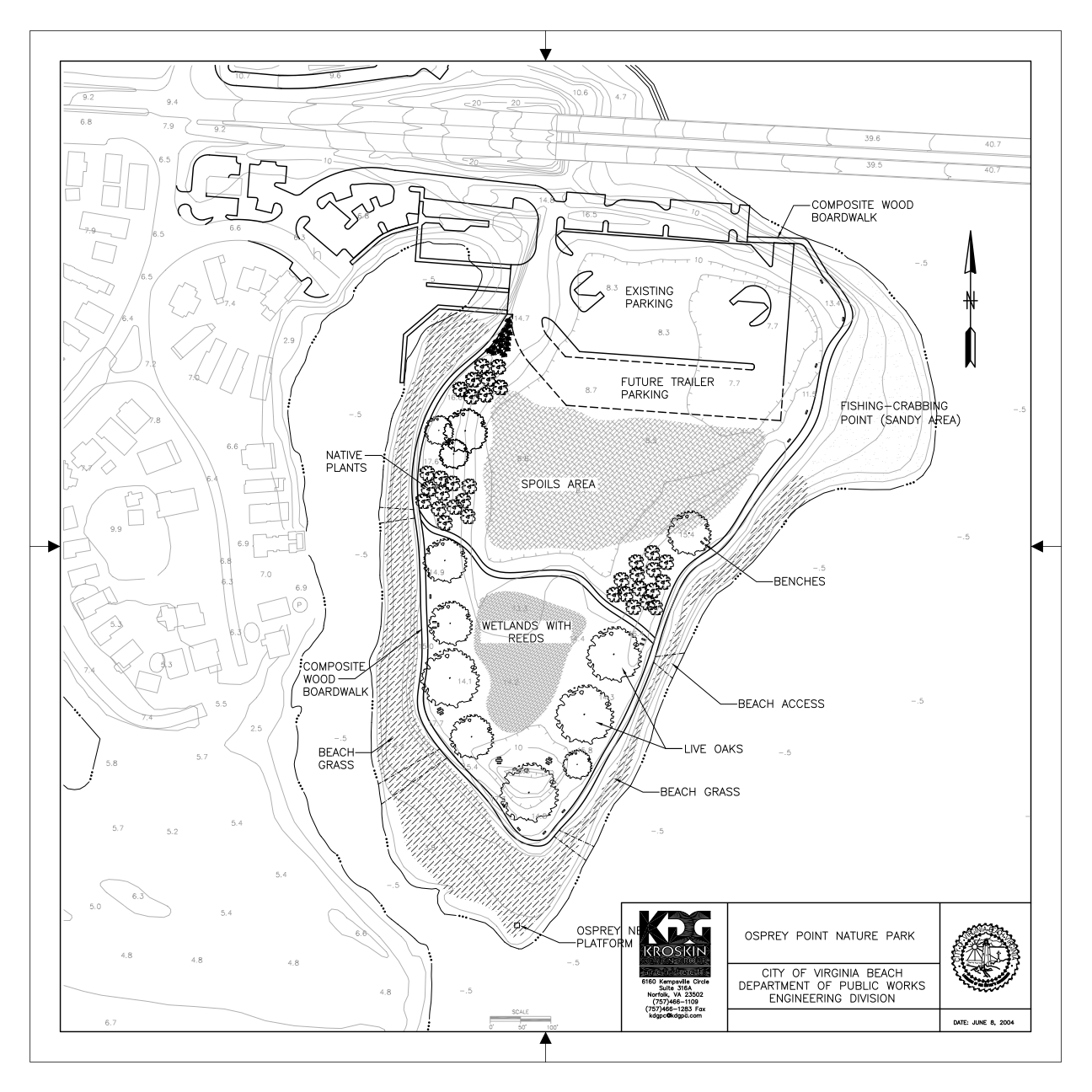
Plans for Osprey Point Nature Park

One of the projects Dan helped formulate was Plans for Osprey Point Nature Park

(Graphic added February 14 2014 by Tim)

SDCC Priorities for 2014

What do our  Shore Drive Community Coalition members want from us in 2014?   What should  SDCC focus on this year? Discussions indicate that some members want us to remain local in focus (Lesner Bridge, Neighborhood Dredging, Shore Drive Storm Water issues, Lynnhaven Estuary Water quality), while others think we need a wider focus (Light Rail, City Budget, Convention Center, etc.).   Obviously, with a limited staff and a time-strapped membership, our resources are tight.  Our ability to tackle only a few key issues would  allow us better focus if we are going to have any chance at having an impact.

Reading the news, we can see some of the looming financial issues of city,  Commonwealth, and Federal government actions.   No one should be that naive to think that the Affordable Care Act (ACA/Obama Care), Public-Private Ventures with Elizabeth River Crossing, and this city’s Light Rail project will have only a minimal impact on our personal and family financial resources.  Many may be sadly awakened if they think that it is only the Portsmouth people and the daily tunnel traffic  commuters that will feel the direct effects of the Commonwealth’s approved Public-Private Venture (PPV) with Elizabeth River Crossing. Previous Governor McDonnell bypassed the State Assembly and signed an agreement that guarantees the private company a 13.5 % profit margin from collected toll revenues per year for decades.

In an effort to make a significant change in the state’s funding of transportation projects, outgoing Governor McDonnell has added to our individual future state tax burden.  How so? Our state’s Constitution requires a balanced budget and any projected deficits must be paid for with either higher taxes, increased fees,  cuts in state programs, or any combination thereof.  There is no state or Federal governmental “Free lunch”.  Someone with money will pay.  Ominously, we may find that this Public-Private Venture business model with guaranteed double digit profits for the owners may be applied to future major state and city projects for more tunnels, bridges, convention centers, hotel renovations, and road projects.

How do we prevent such lopsided projects and outrageous private company’s profits?  Who’s voice will be saying “unfair, unjust, and outrageous “?  How do we find a voice that our city or state government will listen to?   Together, we can be heard and have an impact.  Civic actions start locally when neighbors come together, gather the facts, attend civic meetings and attend City Council meetings.  Informing ourselves with the facts, passing the information, and taking a stand takes from our time, but not speaking out against egregious state and city actions will only take, and continue to take from our wallets and our EZ Passes.

I

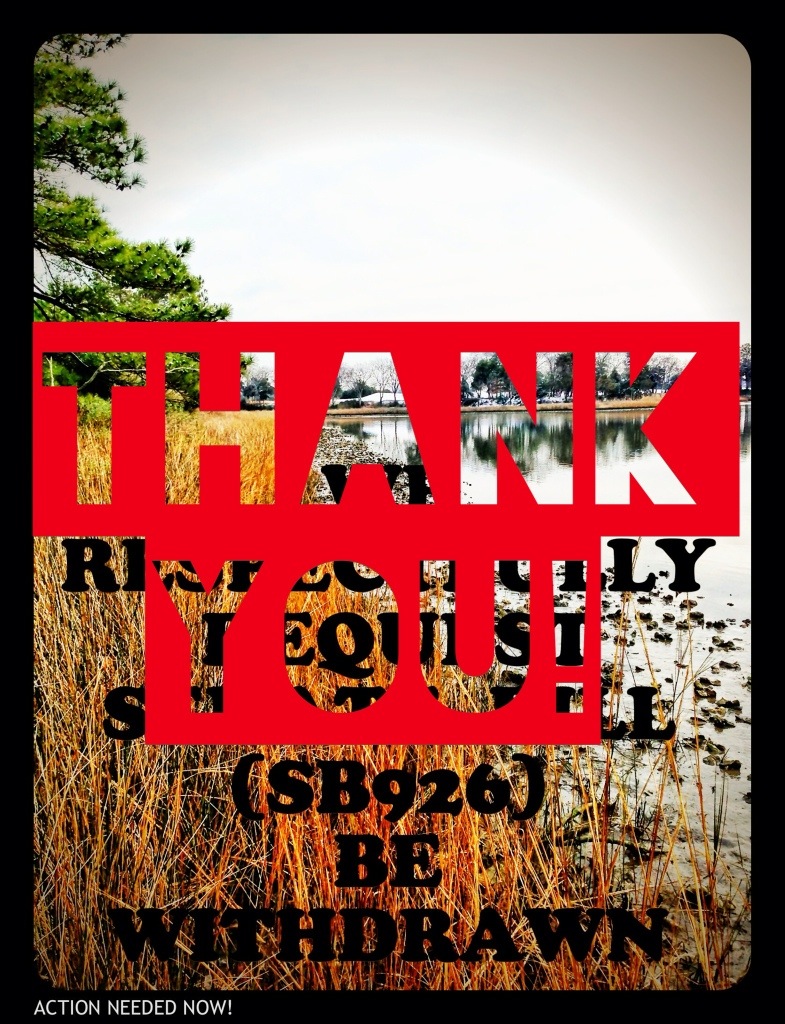
Commonwealth of VA Senate Bill 926 SHUTDOWN!

Senator McWaters has just informed me at 9:28 pm TONIGHT that SB926 will be dropped tomorrow due to the opposition voiced by so many of our civic organizations. He said the bill needs more study and was not ready for prime time. YES!!!!!!! The voice of the citizens CAN be heard when we have dedicated people to group together, inform our members, and collectively express our voice. I thank ALL of you who have voiced your concerns during this intense negotiating period. WELL DONE!

And to Senator McWaters and his very hard working staff, WE THANK YOU!!!!!
20130130-220129.jpg

Flu and YOU!

Everyone should be paying some attention to the recent increase in reported Influenza Like Infections (ILI) as the Center for Disease Control (CDC) reported numbers are rising rapidly.  A cold is manageable with symptoms which we are familiar, but the flu is like you have been run over by a dump truck.  Severe body aches all over which could last for a week or more, etc.  I am not a doc, so I will leave the medicine to those who are qualified, but I am an emergency planner.  The numbers reporting flu symptoms will soon reach pandemic proportions here in the U.S.  Already, Europe is reporting the flu as a pandemic.  Watch this flu virus.  Get yourself a home flu kit (aspirin, Tylenol, Aleve, mineral fluid replacements, Imodium-D, etc.) or what ever your mother would use to help you through.

If you are vulnerable to the flu with a weakened condition, it would not be a time to be visiting the mall for a morning walk.  There are precautions that you can take that will lessen your chances for the virus, mainly washing your hands a lot, avoiding crowds, and especially avoiding neighbors and family with flu symptoms.  Care giving is one thing that we all sign on for as a parent or a spouse, but you should not expose yourself needlessly.  Please watch the news and read the newspaper for information. Take care of yourself and family.

A Large Shaggy Christmas Present Miracle

As our neighbor was about to leave for his short Christmas holiday with his family, a visitor came to stay for a bit.  About 50 pounds of wet black hair planted himself on our neighbor’s front porch. My neighbor called me to ask if I knew the owner of the friendly mature black lab. Not knowing the owner, I called Marty Schuman, president of Cape Henry Shores Civic Association to ask for help.  He gave me the name and telephone of the Neighborhood Watch coordinator, Ms. Regina Wallace.  She quickly put the word out over the internet and text alert system.  Within 45 minutes, we had some nice people picking up a very happy dog who would have otherwise gone to animal control.  Amazing!  One HAPPY family and one very lucky dog who had apparently chased a duck and ventured across Long Creek from Bay Island.  With the timely return of their dog, and his reunion with their sweet young daughter, Christmas was once again made special.  I am sorry, but I didn’t get her name.  I wonder if it is “Virginia”?

Seasons Greetings From SDCC

As we finish the year of 2012, we wish a warm (no global warming reference intended) season’s greetings to all our families and volunteers who have so freely given of their time, efforts, and treasures to maintain and improve the beauty and community of the Shore Drive area. Many, many people have so generously given to others in our area through food, furniture and clothing drives. You have welcomed our troops home, or said “good bye”, and offered a hand to neighbors while watching over our communities to keep them safe for all. Virginia Beach is truly a generous and caring community. Many of you have given without even expecting  a “thank you”. You are beautiful, friendly and caring. You are the heart and very soul of this community that makes you so special. Enjoy your Christmas, Hanukkah, Kwanzaa, or winter solstice. May you personally feel the sense of community with all your neighbors, friends, and family about you.

We wish to give a special “thank you” to our Mayor, City Council members, and city staff for bringing Pleasure House Point to a reality and preserving this incredible public treasure for our future generations. Lynnhaven River Now and Chesapeake Bay Foundation deserve our very special thanks and continued future support.

On behalf of Grace, Todd, Carol, and Tim, may all of you have a MOST SPECIAL HOLIDAY!

CHEERS!!!!!

High Tides for Lynnhaven Inlet and Storm Info

Everyone,
I googled Virginia Beach Tide Chart and found a site “Sunny Day Guide” which provides a tide chart for VB. From their basic tide time, you have to add or subtract a correction for your specific area. The correction for Lynnhaven Inlet is Basic+48 minutes. The corrected high tide for today (Oct 29) will be 10:02 am and 10:31 pm. The corrected high tide for tomorrow will be 10:49 am and 11:07 pm. I hope everyone fares well and stays dry. Be careful and please watch for any down power lines. If there are down power lines in the area, don’t touch anything metal (fence, etc) or even wood like tree limbs. If the voltage is high enough, a wet tree limb can transmit enough voltage to kill you (saw it at a Dominion Power public demo). Be careful. Please watch out for your neighbors who may be by themselves.

If you experience any damage from the storm, take pictures to document the damage for insurance purposes before you remove it.If you have a lot of damage, separate the damaged material into three piles; mulchible (tree limbs, branches), building material (drywall, carpeting, rugs, etc; and then if you have “white goods” like refrigerators, freezers, lawnmowers, powered equipment, put that in a separate pile because of the possible hazardous material (oil, gas, freon, etc). Do not put everything in one pile, or the city will let it sit there for some time before it can be sorted out.

Your Civic Organization and YOU

As you know, there are many civic organizations in Virginia Beach. Of the many, how are  Shore Drive Community Coalition(SDCC), Virginia Beach Council of Civic Organization (VBCCO), and Bayfront Advisory Council (BAC) similar or are they different ? These three organizations were formed to address different issues at the time that were not being adequately resolved at the city level. By providing a collective and representative voice for their group,these organizations sought to be heard by the City Council or the staff that serve the Mayor and Council.  What am I trying to point out?

We, Shore Drive Community Coalition are only as effective as our collective efforts at trying to provide a common voice to the issues that impact our Shore Drive community. Many of us have spoken before VB City Council to present our group’s support or concerns on important issues. This is democracy in a republic. Sometimes we have achieved our objective, while other times we may feel as if we have been  ignored by our elected officials. But, while immediate change usually does not happen, I think civic organizations can bring about change.  Look at the change that has come about with civic involvement.  Ask yourself if change would have occurred if no one spoke?  Obviously change comes from participation in the government process.

The Mayor and City Council have acknowledged and most positively responded to our concerns on “Shore Drive 35 Alive” , needed bike paths, and most spectacularly with Pleasure House Point. These excellent achievements would not have been possible without citizen participation and involvement that was recognized at the City government level.

There are many more major issues that our city is facing or will be facing in the near future.  Our city faces major budget deficits in the next five years that will impact all of us. Some estimates indicate that it will reach $500 million dollars unless additional revenues are found.  Translate that to mean higher taxes from us all.  How our city’s projected deficit will impact the Light Rail question, Sports Arena, Neighborhood Dredging Program, our schools and teachers, libraries, and police and fire staffing levels will all have to be discussed.  We can just listen to our city experts, or we can do our own homework and then work with our civic organizations. Our citizens’ positions should be heard. How does that happen?  More residents will have to step forward and get involved.  More residents need to participate in our city’s civic organizations. Civic organizations are only as effective as their membership.  Get involved.  Come and hear your City Council candidates speak on the 17th at Cape Henry Collegiate 7-9pm.  Come to Shore Drive Community Coalition meeting, 29 OCT 7:30-9:00 at the Ocean Park Volunteer Rescue Squad . If you want the city to listen, sometimes you have to speak with a combined voice.  Change does not occur in a vacuum.  See you there.

Councilman Moss To Speak at 25 SEP SDCC Meeting

SDCC members have an opportunity to hear VB Councilman John Moss speak before our gathering this Tuesday 25 SEPT at 7:30. The meeting will be held at our usual location, Ocean Park Volunteer Rescue Squad Station (Intersection of Shore Drive and East Stratford Rd.). Please note that the normal meeting date (the last Monday of the month) has been changed for this September meeting to avoid conflicting with the VBCCO City Council Candidates Forum to be held that Monday, 24 September. Both the VBCCO meeting and the SDCC meeting will offer our citizens the opportunity to hear about significant city issues that will directly impact us now and in the future.  Come hear Council John Moss speak on this side of the issues.